
For those who venture beyond Emberglow’s edge, time—not distance—is the true limit. The tether to the Skyflame does not snap at a specific point in space, but after roughly fourteen days disconnected from its pulse. This temporal boundary shapes every decision made by wanderers. No matter how far their curiosity pulls them, they must always count backward from that fading edge. The risk is not in the land itself, but in losing the rhythm of return. Once the connection fades fully, they cannot shift again, nor coax the world to shape with them. Beyond that threshold, the form they wear becomes the form they keep.
As such, wanderers grow strategic in their shapeshifting. A fox may offer a low, ground-hugging perspective and access to dense underbrush, but its pace is slow—perhaps five to ten miles a day. A bird might soar and see great distances, but tire quickly and be vulnerable in unfamiliar skies. Some choose endurance forms: long-limbed beasts, desert runners, or gliding creatures who ride the wind. A camel-like form, capable of covering over 100 miles in a day, becomes a powerful tool for those seeking faraway sights without sacrificing return. These Flameborn and Blazekin think in loops, planning their transformations around how many days they can afford to move outward, rest, and still return before sealing sets in.
Their journeys are rarely linear. Instead, they take the shape of rings and spirals—explorations that arc outward for six or seven days, then begin the curved path home. Many keep a mental map of “safe zones”—groves, hills, or caves they’ve visited before—places where they can rest and remember. The longer they journey, the more forms they wear: a wolf for one day, a heron the next, a vine to watch the stars without moving. In this way, each wanderer becomes not one traveler, but many—a chorus of perspectives gathered within a single soul, all racing time, all listening for the slow return of the flame.
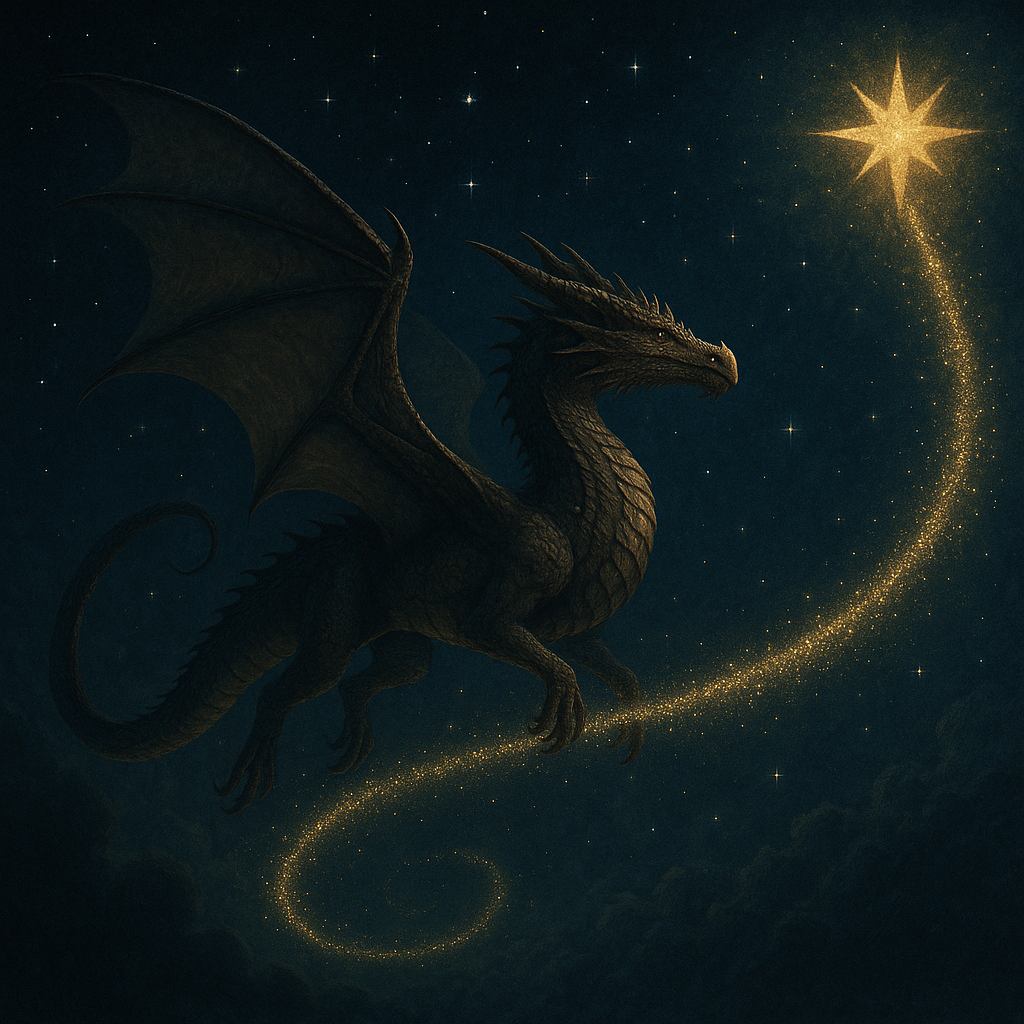
To leave Emberglow as a Skyrend Drake is to become momentum itself. The instant one takes this form, the Skyflame’s breath seems to surge beneath the wings, propelling the Flameborn into the vault of Vravana with a cry that splits clouds. The world falls away in rippling layers—forest, ridge, sea—as the drake rides ley-currents like invisible rivers in the sky. From this height, one sees not only distance, but possibility: the curve of the world, the shadow of old scars, the glint of hidden rivers. In a single day, a Skyrend Drake can cross entire continents, and with each mile, the tether softens—yet the wind sings of return. To fly in this form is to feel both unbound and counted: every heartbeat a step toward the edge of becoming fixed, every wingbeat a decision. The air is thinner, the world more honest. And when the time comes to turn back, the flame in the chest stirs—guiding the flight home before silence sets in.
Traveling Researchers
Emberglow researchers who shift into Skyrend Drakes become mythic silhouettes etched across Vravana’s skies—massive, elegant, and unmistakable. These great winged forms are chosen not only for their speed, but for the vantage they offer: a sweeping, high-altitude view of the land’s rhythms, migrations, storms, and settlements. From this height, a researcher can sketch ley-patterns across entire valleys, observe seasonal shifts in jungle canopies, or witness the growth of civilizations from a distance. Yet their immense size is both a gift and a limitation—too large to pass unseen, too foreign to blend in.
Landing in a populated region presents immediate challenges. The sudden appearance of a Skyrend Drake may trigger panic or retaliation among those unfamiliar with Flameborn shapeshifting. Weapons may be drawn. Alarms raised. Even in open terrain, the researcher must choose landing sites with care—broad cliffs, empty beaches, or ancient ruins where the threat of confrontation is minimal. And even when peaceful contact is possible, the language barrier remains: a Flameborn in drake form cannot speak in local tongues, and few outside Emberglow know the gestures, pulses, or resonance-based communication of their kind. Observation becomes silent, distant, and often lonely.
To preserve and relay what they learn, these Flameborn memorize every contour, behavior, and pattern they see—committing them to resonance-memory. Upon return, these experiences are etched into Embershards, glowing crystal records shaped through flame and form. These shards capture not only what was seen, but the feeling of the moment: the wind shear over mountain ranges, the scent of volcanic ash, the fear pulsing from a village below. Over time, these shards form vast, living atlases of the world beyond Emberglow—imperfect, incomplete, but glowing with awe, caution, and wonder.
Homebound researchers
Not all researchers in Emberglow take to the skies. Many remain within the city’s shifting embrace, dedicating their lives to the study of resonance, memory, coalescence, and the behavior of form itself.
These scholars delve into the deep harmonics of the Skyflame, cataloguing fluctuations in leyflow, patterns in shapeshifting, and the emotional tones that influence transformation. Some record the history of echo-bonds, tracing how memory is carried across generations. Others focus on the philosophical implications of stillness, the sacred geometry of antlers, or the encoded meanings in ceremonial shifts. They write with emberquills into living paper—books that hum faintly as they’re touched—creating works that are less documentation and more ongoing symphonies of thought. Though they never cross the boundary, their writings form the heart of Emberglow’s wisdom, ensuring that what is observed, remembered, or simply felt does not fade.